


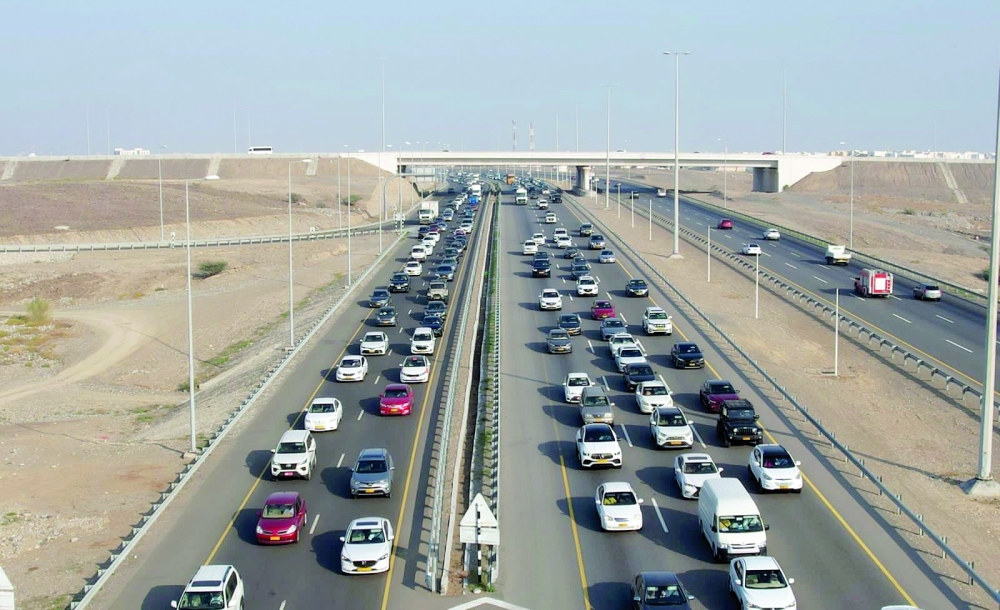





MUSCAT: The Ministry of Transport, Communications and Information Technology (MoTCIT) awarded the Muscat Expressway expansion project, stretching from Al Qurum Natural Park interchange to the Halban interchange, at a total cost exceeding RO 157.2 million.
The ambitious project aims to increase road capacity, ease traffic congestion during peak hours, enhance road safety and significantly reduce travel times.
Eng Khamis bin Mohammed al Shammakhi, Under-Secretary of the Ministry of Transport, Communications and Information Technology for Transport, described the project as a strategic milestone within the ministry’s plans to strengthen the efficiency of the national road network and accommodate Oman’s rapid urban and population growth. He stressed that the expansion will improve connectivity between governorates while providing a safer and more efficient transport environment.
The project includes a broad package of infrastructure upgrades, most notably the conversion of Al Qurum Natural Park and Seih Al Maleh roundabouts into signalised intersections, expansion of the expressway up to the Halban interchange and improved integration with the Al Batinah Expressway.
The scope also includes upgrading bridge entry and exit points through additional lanes and constructing a direct exit at Rusayl Bridge for motorists travelling from Muscat towards Burj Al Sahwa Roundabout.
Additional improvements include standalone flyover bridges designed to streamline traffic movement between major routes, including links from Ruwi to the expressway.
Upgrades will also be carried out at the Al Khoudh Sixth traffic signals to minimise traffic conflict points, alongside enhancements to collector-distributor (CD) roads extending from Al Ghubrah to Al Maabela to improve access and exit movements.

Speaking to Observer, Eng Falah bin Said al Falahi, Manager of the Muscat Expressway Expansion Project, said the ministry has adopted a flexible design strategy that combines the expansion of main carriageway lanes with the introduction of collector roads, tailored to the traffic density and characteristics of each section.
He explained that the primary challenge lies not simply in increasing lane numbers, but in effectively managing traffic conflicts. The collector road system, he noted, is designed to separate local traffic from long-distance through traffic, reducing congestion at merging points and improving both traffic efficiency and road safety.
According to Al Falahi, the main carriageways will cater to through traffic travelling longer distances, while collector roads will primarily serve local residential and commercial areas. Lane distribution will vary according to demand, ranging between three and four lanes for main carriageways and two to three lanes for collector roads.
He highlighted that advanced traffic studies and simulations demonstrated that traffic separation through collector roads is more effective than expanding the highway into six continuous lanes, particularly in densely populated areas. The approach is expected to deliver superior operational performance in both the short and long term.
Addressing traffic bottlenecks in heavily congested areas such as Al Maabela, Al Khoudh and Rusayl, Al Falahi said the project incorporates targeted solutions, including continuous collector roads, enhanced bridge connectivity, direct exits and dedicated flyovers to ease congestion and improve traffic circulation.
He added that the redesigned infrastructure will ensure smoother vehicle movement through dedicated acceleration and deceleration lanes, clear physical separation between traffic streams and improved entry and exit configurations. Importantly, the project has also been designed to accommodate future expansion, including the addition of lanes and operational enhancements as traffic demand grows.
To minimise disruption to commuters, the project will be executed in carefully planned phases supported by a comprehensive traffic management strategy. Measures will include phased diversions, restrictions on construction during peak hours, clear directional signage and continuous coordination with relevant authorities.
The Muscat Expressway expansion project is expected to be completed within 36 months, in addition to two months of preparatory works, underscoring Oman’s continued commitment to strengthening transport infrastructure in line with future development needs.
Oman Observer is now on the WhatsApp channel. Click here


